Mostrando entradas con la etiqueta Sport. Mostrar todas las entradas

jueves, 19 de diciembre de 2013

Behind the mist the Sun is waiting for us…


At 9:30 am local time in Delhi, on Saturday 30 November, the dream became reality. After landing in India, in the arrival’s zone at the Indira Gandhi International Airport, Suki is waiting for me. A young Indian, who as a good host shows me the bus I have to take and gives me the final instructions on how to get to Rurka Kalan.
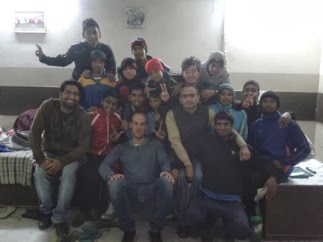
I really enjoy my journey, on both sides of the highway there’s a different world: colorful turbans, endless beards, cows crossing the highway, but I always receive a smile and friendly greeting from everybody with whom I make eye contact. Ten hours later, here I am in the rural Rurka Kalan, greeted by Suny, the architect of my trip and a man full of energy whose effort and enthusiasm is contagious to all who participate in the project of the YFC academy. 

This project aims to create a center for youngsters of the region, hard working people, passionate about football and sports. I believe my role can support the organization and sports development, by contributing what I can in the training of physical education monitors, who one day may become great football coaches.

These two weeks in the Punjab valley have allowed me to experience a different society, a rural environment where one can easily miss aspects of a Western lifestyle, but where you can find tranquility and peace to continue to create a working model based on personal growth.  

Every day I hear a new language, Punjabi, which is like Euskera (the Basque language) for an elderly man from Seville. The children and the adult population do not really understand English, and although the trainers help with translations, I would really like to engage in conversations with people, learn about their worries or simply chat during mealtime with the academy’s residents.

"The day starts misty but all of us know that behind the mist,
the sun is waiting for us"
I wake up at six in the morning and take the first training session until eight, after having a nice Indian tea, thanks to my friend and great chef Sunu. After having breakfast with my colleagues, the children go to school and I stay in the office, to get a better understanding of the infrastructure and needs of this project. After enjoying a really spicy lunch, at 16:30 I complete the second training session of the day, every day with a different group, every day a different experience.   

At the moment, everything is going well. The community is starting to accept me as one of them, the Spanish coach that cycles a bike. I have discovered Kabbadi, a traditional wrestling sport played in Punjab that just celebrated its fourth World Cup.

Satsriakal friends!!!

Keep smiling!!!

Written by Xabi Martin Nebreda, Sport Network's volunteer

martes, 17 de diciembre de 2013

A tribute to our volunteers

The work of volunteers can often go unnoticed. However, the past month has seen people and organisations around the world celebrating the 'international volunteer day'. As a tribute for their support, we would like to acknowledge our volunteers, both past and present, and say thank you for being part of this successful team.


As a non-profit organisation, during the past years we have benefitted from the passion and dedication of numerous volunteers. We recognise that without their support, we would not have been able to make such a positive contribution to societies around the world. Volunteers have provided invaluable support both locally, at our headquarters in Madrid, and internationally, in the communities that we work.

“At Sport Network I was given the freedom to be creative and design my own project but also given the support and resources I needed for implementation. It was a successful project!” Laura, Sport and Cooperation Network volunteer in Madrid. 

“I hope this trip will be magical, will continue to give me the opportunity to learn new ways of life…I have high expectations to continue training as a person and as a coach, to meet people that will share their life experiences with me and I am sure we will become friends for the rest of our lives, and I will be proud every time I tell a story of my time with them.” Xabi, Sport and Cooperation Network volunteer in India.

“I participated in different activities, such as administrative tasks, collaborated in different cooperation projects that the Foundation is implementing in Africa, Central-America and in Madrid. Thanks to this I could learn more about the work of NGOs in this field... [My time at Sport Network] was a great personal and professional experience…” Alonso, Sport and Cooperation Network volunteer in Madrid. 

“Volunteer collaboration has been crucial in Sport Network's history. I would like to acknowledge the work they have done for the organization, especially during the challenging times we are facing.” Carlos de Cárcer, Director of Sport and Cooperation Network.

Do you have any free time? Have you ever wanted to get socially engaged? Do you share our passion for a better world? Do you believe your skills could make a difference? 

If you answered yes to the above questions, then why not send us an email about how you could support our work: rdc@redeporte.org

jueves, 12 de diciembre de 2013

In memory of Nelson Mandela

Prisoner Number:  46664

December 5, 2013 is a day we are going to remember forever; on that day, a great man passed away. For many people Nelson Mandela is the symbol of freedom and equality. He was a man, who was never afraid of fighting against apartheid (system of racial segregation) that had taken over in South Africa until the 1990’s. 

Born in 1918 Mandela received a Western-style education. After finishing secondary school, he continued his university studies in Law. He graduated in 1943 and a year later joined the African National Congress (ANC), which aimed to fight against the oppression lead by the Afrikaners. 

Mandela, often called Madiba, the name given to him by his clan, spent 27 years in prison for having raised his voice against the apartheid introduced by white people in the Republic of South Africa. 

After his release in 1990, Mandela was the main interlocutor of President De Klerk (National Party) in order to negotiate the democratization process. For their common efforts for peace, they shared the Nobel Peace Prize in 1993. 

The first democratic elections in South Africa took place in 1994. After winning the elections, Mandela became the first black president of South Africa. His main objective was the national reconciliation. A key moment was his support towards the rugby team of Springboks, a historical symbol of the apartheid regime, in the Rugby World Cup in 1995. Having won the World Cup, Mandela’s dream came true: the people of South Africa, white and black, for the first time were proud to be South African. 


A lover of boxing, rugby, and football, Madiba understood the power of sport. He acknowledged that sport is a very useful tool that can be used in many areas of life.

"Sport has the power to change the world. It has the power to inspire, it has the power to unite people in a way that little else does." 

Mandela is an example for everybody. He taught the world that we must fight to reach our aims, that we should not give up, and any dream can come true. We should never forget his lesson!


jueves, 19 de septiembre de 2013

International Day of Peace

On the 21st September 2013, the United Nations celebrate the International Day of Peace.
Established in 1981, the International Day of Peace is devoted to strengthening the values of peace throughout the world.

Sport has been recognized as an important tool to convey messages of peace around the world.
As an organisation, we have gained experience of the unique power sport can have on communities afflicted by conflicts.

In a message, 100 days before the international peace day, the United Nations Secretary-General Ban Ki-moon stated, "It is not enough to teach children how to read, write and count. Education has to cultivate mutual respect for others and the world in which we live, and help people forge more just, inclusive and peaceful societies."

We believe that sport provides an environment where people can put their differences aside, build peaceful relationships, respect each other and most importantly have fun.

In eastern Cameroon, we are currently implementing a project that aims to foster social integration among locals and refugees. Refugees displaced from their country of origin face numerous physical and emotional traumas.

In regions where formal education is already limited, the arrival of more people can be impossible to manage. In these situations, sport can be a useful medium to convey key messages and build self-confidence.


We consider that sport and physical activity is the best possible way as it has the capacity to unite people and create friendships: while playing sport we forget all the things that divide us and the barriers disappear. On the field we are all equal. Sport is also a very good means of communication” Jean Pierre Boundar, Sport and Cooperation Network instructor.

Read more about the project in Cameroon


jueves, 18 de julio de 2013

The twelfth player


Taking advantage of the summer holidays, Sport Network is organizing an 11-a-side football championship in Boulembé, which will take place on the recently inaugurated sport fields, constructed as part of the project “Improvement of life conditions for Central African Refugees in Cameroon”

The inauguration of this eagerly awaited event took place on the 13th of June with the celebration of the first football games. The tournament will conclude on the 25th of August, with a grand final. 

The tournament has had a fantastic reception from the participating teams, as well as spectators that come together every Thursday and Saturday to support their teams. All of this combines to create a fun, festive and sporty atmosphere that unite families, youth and children, as well as multiple vendors selling; donuts, corn on the cob, bananas, peanuts, meat and drink. 

The level and commitment of the players is very high, always led by their coach, who gives instructions and makes changes from the side of the pitch. However, I dedicate this blog to the 12th player of each team. They are the most tireless, the most loyal and I have to say the craziest and loudest players of the tournament, and it’s none other than the supporters of each team. The fans can almost feel more involved than the players themselves, they suffer from every decision made against their team, they celebrate each goal as if it was a goal in the final and while the game is played, they continue to debate refereeing decisions. 

The most beautiful thing about sports and football in particular, is the passion that it generates and its ability to mobilize people. And here we are not talking about famous football clubs that spend millions and millions of Euros on players and advertising. We talk about passion that arise in ordinary people, who enjoy living the sport, either as a player or supporter, and who take pleasure in the capacity to unite people through a common passion regardless of age, gender, religion or nationality. And for this we don’t need many resources, just a bit of creativity, which is highlighted in Africa, where players in the tournament lack proper football boots and play in sandals (the ones that are used on the seaside to prevent accidents caused by rocks).

The tournament continues under the watchful gaze of their 12th player. Stay informed to find out who wins!! 

Find out more about the community championship in Cameroon!

Written by África Coloma a Sport Network volunteer in Cameroon

viernes, 5 de julio de 2013

My experience in Zambia


My work as a volunteer at City of Hope was focused in a center, within the same complex, called Auxilium Training Center. It’s a school where youngsters from the area can gain new skills, to enhance their future employment opportunities. In the course that I participated, subjects like Communication Skills, Catering, Tailoring and Information Technology were taught. In addition to the core subjects, First Aid and Physical Education were part of the school week.

My duties
I was in charge of the Information Technology class, which was offered to the Catering and Tailoring students and anyone else that showed special interest. The groups were divided as such:

  • I.T. group: a group of 8 students (6 girls and 2 boys) aged between 17 and 20 years. Only a few of them have had previous computer experience and almost all of them have finished secondary school (12th grade). 
  • Tailoring Group: a group of 25 students (24 girls and a boy) whose ages were very varied.

I gave classes in the computer lab, which was equipped with 10 working computers. The computers were given to City of Hope by several donations. My first task was to setup the computers and erase previous data. Unfortunately, the computers do not currently have access to the Internet, but still provide a good basis for teaching basic computer skills.

The tailoring group was predominately formed of women of various ages. Many of the women in the tailoring group had little interest in learning computer skills, as they considered it a tool for men, and for many it was also the first time they had seen a computer.

My experience with the I.T. group was very different, as it’s a group that particularly wanted to participate in this class. Nevertheless, it is hard for the students to study after school, as many of the students don’t have any free time due to their family situation. For example, one of the pupils is living with her father, brothers and uncles, and being the only woman at home she has to take care of the whole household, as men don’t typically deal with domestic tasks.

However, it seems that sport and physical education provides a useful tool to transmit values and promote gender equality.

The other activity that the center organized was Physical Education. We dedicated one hour per week to formal PE lessons and I can tell they were greatly appreciated. The PE lessons, which included Volleyball, football and handball, were conducted at City of Hope’s sports facilities.

Each week we practiced a different sport, to avoid focusing solely on football, even though that’s the most popular sport in Zambia. Every class had two parts. During the first part we focused on the technical and tactical aspects of the sport, and then during the second part we played a game, putting into practice what they have learned during the first part of the class.

In volleyball and netball, sports that I have no experience in, some of the students helped me out, preparing activities for the first part. It was a big success given that girls - who were hesitating at the beginning – helped me voluntarily in the implementation of the activity.

On weekends we had different sporting competitions. On Saturdays 20 boys, aged between 13 and 20 years, from the area visit the City of Hope to play football or handball. City of Hope also participates, with great success in championships organized by other teams in the area. 

The football pitch, which has undoubtedly the most demand, is not in the best condition. The pitch has many stones, which can be quite dangerous, as many of its users play barefoot. Nonetheless, the atmosphere was nice and friendly, the boys spend Friday afternoon, Saturday and Sunday at City of Hope, getting to know each other and the girls from center. 

Miguel was a Sport and Cooperation Network volunteer in Zambia, sent by the Castilla y León “Youth Solidarity” program. 

How to help
You can help support the City of Hope project, by making financial or inkind donations. The money received will help supply, sports equipment, footwear etc… 

jueves, 20 de junio de 2013

World Refugee Day 2013

Today, June 20th, marks the United Nations World Refugee Day. A day, where people in countries around the world will be recognizing the strength and determination of those forcibly evicted from their homeland. The United Nations Secretary-General Ban Ki-moon stated, ...Refugees leave because they have no choice. We must choose to help”. It is a time when people can reflect and raise awareness of the situation of refugees around the world and show global solidarity.

Refugees face physical and emotional trauma when they are displaced from their country of origin. However, sport can provide a useful distraction and tool to build self-confidence, encourage teamwork and foster peaceful relationships between the host and refugee community.

Sport Network believes that sport is a powerful tool for human and social development. Sport, not only provides a healthy lifestyle for children and adults alike, but can also encourage children to attend school, raise awareness about health issues, promote gender equality and foster integration.

On World Refugee Day, we take this time to reflect on a number of our projects that have supported refugee and host communities around the world.

Cameroon
Sport Network, is currently implementing a project in Cameroon, which aims to improve the quality of life of refugee and local communities in the Eastern region, through education, sport and socio-cultural activities.

Once they have a place to play, the kids will forget, even if for a moment, about their problems and their differences” Sport Network coordinator.

To facilitate this aim, Sport Network in collaboration with the United Nations High Commission for Refugees (UNHCR) has constructed a primary school and sporting facilities, which include, two football pitches, as well as volleyball and netball courts. A key aspect, of the Cameroon project is the training and education of young people as peer leaders, which will contribute to the success and sustainability of the project.


Algeria
Sport Network have completed two projects in the Sahara that aimed to improve the living conditions of children and youth, living in refugee camps by promoting sports and education. The projects involved the construction of sporting facilities, training sport monitors, arranging cultural and sporting activities as well as the publication of a bi-lingual (Spanish and Arabic) handbook of Physical Education. The second project, which included the publication of a handbook was part funded by the UNHCR.


Read more about the projects in Algeria!


martes, 2 de octubre de 2012

My experience at Sport Network


My name is Alonso Berrelleza; I am Mexican, and 26 years old. I completed a four months internship at the NGDO Sport and Cooperation Network, from 25th April until late August.

How did I get to Sport Network? To be honest, my main objective was to travel to a different country, immerse myself in the culture, meet new people from other parts of the world and enjoy the experience of living in a foreign country. But I also needed to do an internship in the frame of my master studies in International Economic Relations and Cooperation that I was studying in my city, Guadalajara, Mexico.

With these clear ideas, I started to seek an internship on the Internet. I wanted to engage in the field of sports, since my previous experience in the field was very satisfying. I couldn’t have made a better decision.

I found Sport Network when I Googled “sport and cooperation”, this NGDO was the first result found by Google. I have read a little bit about the organisation on their website and then sent an email expressing my interest. The positive response from Carlos de Cárcer, General Director, was almost immediate.

In the first email, I received all the information about how to get to the office. From my first day and throughout the four months at Sport Network, I participated in different activities, such as administrative tasks, collaborated in different cooperation projects that the Foundation is implementing in Africa, Central-America and in Madrid. Thanks to this I could learn more about the work of NGOs in this field, their administration and planning, the implementation and completion of projects, and their tough financial situation of these days.  

Gently I dig into the topic of sport s and development, its history and the different kind of projects that NGOs are carrying out currently.

One of the most enriching experiences was the opportunity to join Sport Network’s team to Rome (Italy) to participate in the final session of the MIMOSA (Migrants Inclusion Model through Sports for All) project. This event gave me the chance to meet new people, NGOs and projects from different European countries, all of them sport-related with the aim to help in human issues, such as migration, social inclusion and humanitarian aid. 

Finally I can say that, without any doubt, it was a great personal and professional experience, the fact that I have been an intern in a Foundation, surrounded by people who are as engaged in topics like sports and development as Carlos and María, helped me a lot in defining more clearly towards which field of profession I want to devote, which is no other than, continuing in the field of sports to help people.    

Moreover, no less important was the work together with Sport Network’s collaborators like Carlos, Esperanza, Marta, Oscar and María, as well as other interns, namely Maira, Laura, Makoto, Lena and the IT staff who provided me great support during my stay. This was essential for my integration and development at the Foundation.

I have beautiful memories about all of them, experiences, valuable friendships and one can never know, maybe the possibility of a future collaboration with them.

Thus, it remains to render thanks to Carlos and Sport Network for the opportunity they gave me to live this great experience. I take nice memories and unforgettable moments with me and I really hope that this friendship and collaboration doesn’t end here, but it can continue for a long time in the future.

Thanks a lot!