Mostrando entradas con la etiqueta Sport Network. Mostrar todas las entradas

jueves, 27 de febrero de 2014

Zero Discrimination


This Saturday, 1 March, is the international day of Zero Discrimination. We believe that everybody deserves the right to live a long and dignified life, irrespective of race, religion, sexual orientation, nationality, disability or gender.

#zerodiscrimination
There is NO room for discrimination in society. Nationally and internationally we have promoted inclusion and raised awareness about issues of discrimination, in an effort to celebrate diversity.

People who discriminate narrow the world of others as well as their own. I believe in a world where everyone can flower and blossom” Daw Aung San Suu Kyi, Nobel Peace Prize Laureate

As the first international day of Zero Discrimination approaches, we take this time to reflect on a number of conferences we held last year.

Raising awareness about discrimination and promoting diversity
During 2013, Sport Network organised two conferences in Madrid. The first, held in April, encouraged dialogue about issues of social inclusion and power of sport in the development context; and the second discussed ‘Racism, Discrimination and Diversity in Football’.

The second conference included a diverse panel of speakers, including academics, grassroots organisations, campaign groups, football clubs and a former professional footballer. During the conference, zero tolerance at the top level and education at grassroots level were emphasised as important in addressing the issues of racism and discrimination in football. All agreed that more cooperation is required and that the media have a key role to play.

Paul Elliott, former professional footballer, emphasised the importance of “zero tolerance sanctions at the top, but education, role models and leadership at the grassroots”.

Forming a collective voice
As an organisation, we believe that raising awareness is key to tackling issues of discrimination. As a member of the FARE Network, we have participated in a number of events aimed at tackling discrimination and promoting diversity. The FARE Football People Action Weeks provide a fantastic opportunity for organisations to form a collective voice against issues of discrimination and celebrate diversity. 

Everyone can contribute to the fight against discrimination. Follow the UNAIDS campaign via social media, using the hashtag #zerodiscrimination

Be the change you wish to see in the world” – Mahatma Gandhi

jueves, 30 de enero de 2014

The value of people


The chain of people, the value of favours, the mixture of phrases that help us move forward.

"I surprised everyone with my speciality,
pasta salad, for Christmas dinner
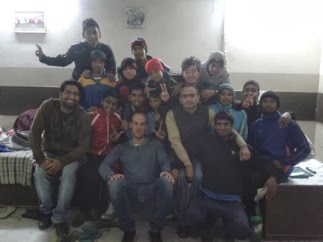
Today, I want to talk about the people, people that are vital to me in India. New friends who make me laugh, friends that explain ancient Punjabi traditions or translate interesting conversations. They are my “Pajis”, a term meaning “big brothers”.

I’ll be honest, during the Christmas season, I missed family, friends, the turrones, the roscones, and of course, thought lots about Ti… However, I took refuge in the smile of the residents of the academy. Like me, they were far from their loved ones but did not understand the reason for my sadness.

Sunny Paji, is the president of Rurka Kalan, but also a great friend who wishes me a good morning everyday. He greets me with a genuine smile and asks me if I need anything. He is a friend who in the evening joins me for a stroll around the football field, talking and dreaming of great projects. He is the friend who invites me for dinner and speaks to me with trust.

Gurinder Sir, is the operations manager, but also the friend who makes me laugh in the office and patiently translates and explains anything I do not understand.

Prateek Chawla is the project and development manager. He is young and passionate about football. He is a friend who stays up late with me to watch live games. He’s always willing to learn and develop.

Gary Paji, is the star man, not because he has over 1 million followers on facebook, but because he is a friend that talks to me about the needs of his village.

Badhu Paji, speaks Spanish and teaches me Punjabi. He is a person that you could spend hours listening to his stories. Budhu, lived in Boliva for two years, and travelled around South and Central America for 18 months.

I would also like to mention, Biri Paji, my Punjabi teacher…Raju Paji our driver… Shandip Paji, secretary and friend who is always full of optimisum…. and more, many more.

The rest is fine. A lot of children, a lot of football, courses with coaches that are willing to learn, celebrations for the “happy Lorhi” or “Maghi Festival”, and the start of the EFL, a football tournament for kids.

From somewhere within the Punjab valleys, where crops grow and sugar canes are cut, the Spanish coach that rides a bicycle is always passionate about telling his story.

Keep smiling!!!

Written by Xabi Martin Nebreda, Sport Network's volunteer

jueves, 19 de diciembre de 2013

Behind the mist the Sun is waiting for us…


At 9:30 am local time in Delhi, on Saturday 30 November, the dream became reality. After landing in India, in the arrival’s zone at the Indira Gandhi International Airport, Suki is waiting for me. A young Indian, who as a good host shows me the bus I have to take and gives me the final instructions on how to get to Rurka Kalan.

I really enjoy my journey, on both sides of the highway there’s a different world: colorful turbans, endless beards, cows crossing the highway, but I always receive a smile and friendly greeting from everybody with whom I make eye contact. Ten hours later, here I am in the rural Rurka Kalan, greeted by Suny, the architect of my trip and a man full of energy whose effort and enthusiasm is contagious to all who participate in the project of the YFC academy. 

This project aims to create a center for youngsters of the region, hard working people, passionate about football and sports. I believe my role can support the organization and sports development, by contributing what I can in the training of physical education monitors, who one day may become great football coaches.

These two weeks in the Punjab valley have allowed me to experience a different society, a rural environment where one can easily miss aspects of a Western lifestyle, but where you can find tranquility and peace to continue to create a working model based on personal growth.  

Every day I hear a new language, Punjabi, which is like Euskera (the Basque language) for an elderly man from Seville. The children and the adult population do not really understand English, and although the trainers help with translations, I would really like to engage in conversations with people, learn about their worries or simply chat during mealtime with the academy’s residents.

"The day starts misty but all of us know that behind the mist,
the sun is waiting for us"
I wake up at six in the morning and take the first training session until eight, after having a nice Indian tea, thanks to my friend and great chef Sunu. After having breakfast with my colleagues, the children go to school and I stay in the office, to get a better understanding of the infrastructure and needs of this project. After enjoying a really spicy lunch, at 16:30 I complete the second training session of the day, every day with a different group, every day a different experience.   

At the moment, everything is going well. The community is starting to accept me as one of them, the Spanish coach that cycles a bike. I have discovered Kabbadi, a traditional wrestling sport played in Punjab that just celebrated its fourth World Cup.

Satsriakal friends!!!

Keep smiling!!!

Written by Xabi Martin Nebreda, Sport Network's volunteer

martes, 17 de diciembre de 2013

A tribute to our volunteers

The work of volunteers can often go unnoticed. However, the past month has seen people and organisations around the world celebrating the 'international volunteer day'. As a tribute for their support, we would like to acknowledge our volunteers, both past and present, and say thank you for being part of this successful team.


As a non-profit organisation, during the past years we have benefitted from the passion and dedication of numerous volunteers. We recognise that without their support, we would not have been able to make such a positive contribution to societies around the world. Volunteers have provided invaluable support both locally, at our headquarters in Madrid, and internationally, in the communities that we work.

“At Sport Network I was given the freedom to be creative and design my own project but also given the support and resources I needed for implementation. It was a successful project!” Laura, Sport and Cooperation Network volunteer in Madrid. 

“I hope this trip will be magical, will continue to give me the opportunity to learn new ways of life…I have high expectations to continue training as a person and as a coach, to meet people that will share their life experiences with me and I am sure we will become friends for the rest of our lives, and I will be proud every time I tell a story of my time with them.” Xabi, Sport and Cooperation Network volunteer in India.

“I participated in different activities, such as administrative tasks, collaborated in different cooperation projects that the Foundation is implementing in Africa, Central-America and in Madrid. Thanks to this I could learn more about the work of NGOs in this field... [My time at Sport Network] was a great personal and professional experience…” Alonso, Sport and Cooperation Network volunteer in Madrid. 

“Volunteer collaboration has been crucial in Sport Network's history. I would like to acknowledge the work they have done for the organization, especially during the challenging times we are facing.” Carlos de Cárcer, Director of Sport and Cooperation Network.

Do you have any free time? Have you ever wanted to get socially engaged? Do you share our passion for a better world? Do you believe your skills could make a difference? 

If you answered yes to the above questions, then why not send us an email about how you could support our work: rdc@redeporte.org

jueves, 28 de noviembre de 2013

Pre-departure: Xabi's expectations

I will begin with a short introduction, my name is Xabi Martin, I am from Bilbao, Spain, and I am starting an exciting project with Sport and Cooperation Network (SCN) in the distant and colorful India.  I hope this trip will be magical, will continue to give me the opportunity to learn new ways of life, and to see if it is always as valid and correct as others think.

I have high expectations to continue training as a person and as a coach, to meet people that will share their life experiences with me and I am sure we will become friends for the rest of our lives, and I will be proud every time I tell a story of my time with them.

I have known the impact of cooperation for several years after taking the specific course in INEF in Madrid, together with the group DIM, a new field where licensed Physical Education teachers and coaches are continuing our variety of work.  The level of the cooperation that fills a person, makes one feel valuable and useful.  The long projects through SCN are a challenge for me, I hope being with the kids in India is a good experience for everyone, and we can open many doors for future collaborations.

Now to discuss the project in India, YFC Rurka Kalan, I hope the people are passionate for football; therefore we will already have something in common.  I hope to learn their football, their sports, and their organization, to be able to see spectacular sports together with them, something that I am passionate about.  If everything goes well, we will watch the Athletic Bilbao matches and I can recruit new supporters!

In 2008, I had a very rewarding experience when I worked on a cooperation project in Peru together with the people of ADDVES, their president, and my friend Juan Abanto, at the head.  We worked on the Villagol Project, where they created sports schools in the human settlement Villa el Salvador, where they performed instructional training course for sports educators and encouraged female football with the participation of a girls team in various tournaments.

Sports are my life and I have made my passion my profession. I always see the good side of education through sports and the positive values generated by of team sports, such as football.  Values like the sense of belonging in a group, team values, being together with a friend, and being able to do something for him, which in turn is good for you; there is no better sensation than that, being together in victory and defeat.

In conclusion, I would like to talk about the factor that I see as the most important and most popular these days, the role of the coaches, instructors, and trainers, with their performances, they represent a person very important in child’s education, not only in their sports education, but also personal growth.  The example will always be in a sporting group, knowing how to interpret the needs of each environment, each family, and each child.

That is all…LONG LIVE FOOTBALL!  LET’S GO YFC RURKA KALAN!

SMILE!

Written by Xabi Martin Nebreda, Sport Network's volunteer

miércoles, 6 de noviembre de 2013

Cameroon - Second short story

Aminatou Gambo 

Aminatou Gambo’s eyes are smiling when we meet. She is an imposing woman: tall and joyful, she always greets us with Merci or Bonjour, the few words she knows in French. Even though she doesn’t remember when she exactly came to Cameroon, she tells us that she was part of the first refugee groups that settled in Boulembé in 2005. In the Central African Republic she made a living by subsistence trade: she was selling milk, corn flour and peanuts. Aminatou Gambo widowed shortly before the situation in the country deteriorated, so on her own she had to find a way of protecting her 9 children when bandits and rebel groups arrived in her village to steal cattle and kill locals. Every night, Aminatou Gambo brought her children to the countryside to sleep, as to avoid staying in her house and being an easy target. Finally, she decided to sell the few cattle she still had and pay a car to take her family to the Cameroon border. Through Sport Network funding, she is working the field and sells the clothing she makes, thanks to the machine donated in the frame of this project. With the benefits she earns through her trade, she is dreaming of buying a goat and a good bed.

Read the introduction and the first short story about our beneficiaries in Cameroon.

Written by África Coloma, Sport Network's volunteer in Cameroon

miércoles, 23 de octubre de 2013

Cameroon - First short story

Aissatou Bakari

We meet Aissatou Bakari in the shed constructed in Boulembé, where every Tuesday, women participating in the income generating activities (IGAs) meet to calculate the value of their weekly incomes. Quietly she tells us that she came to Cameroon five years ago, together with her husband and their six children, after fleeing Central African Republic, as the security situation was untenable. They left their home during the night, without looking back; they walked for long hours until, at the first light of the morning, they reached the car that would take them to the Cameroon border, and their entrance to a safer environment and a new life. After spending time in a UNHCR refugee camp, finally they settled down in Boulembé, their new home. Through Sport Network’s funding, Aissatou started to work with manioc (Cassava work) and she notices how her life has got better, her three children can now attend school in the neighboring village. With the benefits that she has been gaining, Aissatou would like to buy a calf and keep her children going to school.

If you'd like to read more about our project in Cameroon, click here, or visit our webpage.

Written by África Coloma, Sport Network's volunteer in Cameroon

jueves, 10 de octubre de 2013

Cameroon: Short stories about our beneficiaries

This is the first in a series of articles about the different groups of beneficiaries of the project “Improvement of life conditions for Central African Refugees in Cameroon”.

Since 2005, Cameroon has welcomed over 104,000 refugees from the Central African Republic who are fleeing from bandits and rebel groups that attack Mbororo settlements in order to steal cattle and kidnap women and children for ransom. For this reason, the Mbororos are forced to sell their livestock and take refuge in the neighboring country, Cameroon. The refugee population is present in over 300 Cameroonian communities. 

The Central African Republic, which ranks as one of the world’s poorest countries, has seen its conflict exacerbated since the events in March 2013. A coup d’etat lead by the rebel coalition “Seleka” overturned the former president and forced people to leave the country. Approximately, 4,200 persons left for Cameroon, 40,500 for the Democratic Republic of the Congo, 13,000 for Chad and 4,800 for Congo. The access to humanitarian aid in this “forgotten conflict” is very difficult and according to the United Nations High Commissioner for Refugees (UNHCR) – with which Sport Network is conducting its intervention – mortality rates and acute malnutrition among the population is very high. 

It is in these circumstances that Sport Network supports a group of 50 women (35 refugees and 15 Cameroonians) of the Boulembé community, thanks to the introduction of income generating activities (IGAs), in the shape of training about agricultural techniques and small business financing.


The ethnic Mbororo’s, which the refugees belong, are essentially nomadic livestock farmers and therefore do not know as much about agriculture, and for this reason their food supply is very limited. Thanks to this project financed by the Spanish Agency for International Cooperation for Development (AECID), Sport Network has trained 50 women on agricultural techniques through demonstration plots of different crops. Subsequently, they put into practice their newly gained knowledge on their individual fields, thanks equally to the distribution of seeds. The new incomes enable them on one hand to improve their nutrition, and on the other hand, enable them to sell their products at the market.

The first in the series of stories will be shared in the coming weeks!


Written by Beatriz Gómez, Sport Network's coordinator in Cameoon

martes, 1 de octubre de 2013

Part 3: Stories from Ethiopia


Aregawi Tadel and his daughter are part of a large family of 9 members from 3 generations. Aregawi and his family live in Agulae and own 0.75 hectares of land that produce 10 quintals a year. They get the chance to harvest twice a year, one in October after the rainy season and the second one around May. His family is very hard working. They mainly cultivate onion, pepper, corn, wheat and teff-cereal endogenous of Ethiopia. 


Despite massive efforts the annual purchase rate of the whole family does not reach 10.000 Birs (430 Euros per year). Alemat, looking mischievous and lively combines school with work on the farm. As we talk, she expresses her desire to improve female opportunities, to enjoy greater access to knowledge and aspire to achieve greater rights, just like any youngster from elsewhere.


Sport Network is currently implementing a project to reduce food insecurity among the population of Kilte Awlaelo. 

During the past months we payed tribute to the beneficiaries of our projects, by sharing a series of stories that reflect the lives and scope of profiles participating in our project.

This is the last one in a series of articles about our beneficiaries in Ethiopia.
Part 2: Stories from Ethiopia

Project Information:
For more information about our project in Ethiopia

Marta is the RDC project coordinator in Ethiopia  


jueves, 25 de julio de 2013

Ethiopia: Portraits and success stories


With a population of 82 million and a human development index (HDI) among the lowest in the World, Ethiopia is one of the most fascinating countries, with a vast and rich ancient culture. The ancient Abyssinia is a country of contrasts where poverty and famine combine with a growth rate that is almost 10%. It is thought that 80% of Ethiopians depend on agricultural activity and 18% of its population cannot satisfy their basic nutritional needs. However, in Ethiopia there is hope, they are willing to fight and above all show an admirable capacity of self-sacrifice and resilience.


Tigray is one of the Northern regions of Ethiopia, which has suffered the most from the curse of poverty, exacerbated by the war with Eritrea, and famines that have occurred cyclically since the 70s. The population suffers from water scarcity, desertification, limited access to land for cultivation, lack of access to innovation and technologies, limited access to credit and low yields. Fortunately, during the last five years nature has been slightly forgiving with this region, which made it possible for the village of Tigray to begin recovering, thanks in part to international cooperation programs aimed at sustainable human development.
    

This is the case of Sport’s Network’s project in the districts of Mesanu, Mehebereweini and Agulae, which belong to the border region of Tigray, where it intends to improve food security for the population, in particular the farmers. The project includes several activities, such as the construction of an irrigation channel, the training of farmers, distribution of improved seeds to increase yields and the establishment of a corporative of women farmers. All of these programs are supported by the community. The community takes part in every phase of the project and has participated more proactively than we could ever expect.

During our work in the field, we have witnessed the incredible drive, enthusiasm and appropriation that farmers from the region have for their development project. Sport Network’s project, which is being implemented in Ethiopia, will directly benefit 105 families with an average of 6 members per family. For the design of the project, one of the main agreements was that the community would actively contribute its labour in the implementation of the project. Currently, we have several members of each family, who far exceed their commitment: collecting, carving and carrying stones and sand, as well as contributing to the construction of the irrigation ditch.

In the name of Sport Network, we would like to thank and highlight the talent and good work of the beneficiaries of our projects, which have made the implementation a pleasant journey. A journey that has faced challenges, but at the same time, it has been extremely satisfying. And behind the numbers and statistics there are real lives, persons with their own history of experiences about self-sacrifice and triumph.

During the coming months we would like to pay tribute to our beneficiaries, by sharing a series of stories that reflect the spectrum of profiles participating in our project. 

The first in the series of stories will be shared next month!

lunes, 15 de julio de 2013

A gift to Peruvian children

Last month, Bea Blanco delivered shirts and a number of footballs on behalf of Sport Network, to the NGO S.O.S. Peruanitos / Voluntariado en Perú. Bea is a friend of Sport Network and is currently volunteering with the Peruvian NGO. The shirts given to Sport Network by UEFA include a written message against racism.

The NGO S.O.S. Peruanitos is a nonprofit organization located in Peru, in the city of Trujillo. It develops its work in the Town center in the Nothern part of “El Porvenir” district. S.O.S. Peruanitos provide alternative education for children living in extreme poverty who cannot attend public institutions of education. That’s why they are implementing an educational project, which aims to support the inclusion of primary school children in the Peruvian formal educational system.

Based on Peru’s social reality and in particularly that of “Alto Trujillo’s” town centre and its numerous districts, there is a large number of children affected by economic poverty, problems of violence, moral neglect, emotional problems, and situations of social exclusion. S.O.S. Peruanitos consider education as a fundamental key for the country’s development as well as for its population, thus contributing to the fight against illiteracy and this way improving Peru’s educational system, reaching sectors of the population forgotten by the Government.

The NGO’s team is composed of national and international volunteers, which is enriching for the children, as it teaches values of cultural diversity and equality. Classes like reading, writing, math, English, art, personal hygiene, values and ethics are taught. The aim is to provide children with skills, education and self-esteem, focusing on the future integration of children in the formal education system. At present they are working with 30 children a year due to the limitation of their installations.

During the school year the social worker would go door to door, collecting information about families, a follow-up about the kids, focusing on helping children in the school, and promoting the family involvement in the educational process of the child. They would meet each week with pupils’ parents to advise, inform and support the kids study process, ensuring good communication between school and family in order to achieve the aims.

How was the presentation of the material?
Very touching, the children received the gift with great enthusiasm.
Many of them after receiving the T-shirts, immediately put them on and went home wearing them.

On behalf of S.O.S.Peruanitos, thanks a lot Sport Network!

For more photos visit our Facebook page!

Bea Blanco is a friend of Sport Network

jueves, 20 de junio de 2013

World Refugee Day 2013

Today, June 20th, marks the United Nations World Refugee Day. A day, where people in countries around the world will be recognizing the strength and determination of those forcibly evicted from their homeland. The United Nations Secretary-General Ban Ki-moon stated, ...Refugees leave because they have no choice. We must choose to help”. It is a time when people can reflect and raise awareness of the situation of refugees around the world and show global solidarity.

Refugees face physical and emotional trauma when they are displaced from their country of origin. However, sport can provide a useful distraction and tool to build self-confidence, encourage teamwork and foster peaceful relationships between the host and refugee community.

Sport Network believes that sport is a powerful tool for human and social development. Sport, not only provides a healthy lifestyle for children and adults alike, but can also encourage children to attend school, raise awareness about health issues, promote gender equality and foster integration.

On World Refugee Day, we take this time to reflect on a number of our projects that have supported refugee and host communities around the world.

Cameroon
Sport Network, is currently implementing a project in Cameroon, which aims to improve the quality of life of refugee and local communities in the Eastern region, through education, sport and socio-cultural activities.

Once they have a place to play, the kids will forget, even if for a moment, about their problems and their differences” Sport Network coordinator.

To facilitate this aim, Sport Network in collaboration with the United Nations High Commission for Refugees (UNHCR) has constructed a primary school and sporting facilities, which include, two football pitches, as well as volleyball and netball courts. A key aspect, of the Cameroon project is the training and education of young people as peer leaders, which will contribute to the success and sustainability of the project.


Algeria
Sport Network have completed two projects in the Sahara that aimed to improve the living conditions of children and youth, living in refugee camps by promoting sports and education. The projects involved the construction of sporting facilities, training sport monitors, arranging cultural and sporting activities as well as the publication of a bi-lingual (Spanish and Arabic) handbook of Physical Education. The second project, which included the publication of a handbook was part funded by the UNHCR.


Read more about the projects in Algeria!


sábado, 24 de noviembre de 2012

Being an intern at Sport Network


I am a graduate student of social work from the United States. I worked with Sports Network and Cooperation to complete summer internship hours through my University in Michigan. I lived in Madrid and worked in the organization’s office in Alcobendas. My experience was unbelievable! 

Working with Sports Network and Cooperation I was able to put educational skills in administration, program development, and program implementation into practice. Although I had a background in Spanish, my vocabulary improved as I navigated through the previously unfamiliar business and financial jargon. 

Organizing activities for my project
I worked in financial reporting of prior sports projects employed in Africa. Working in this, I was involved in the micro process of reviewing invoices and financial statements but also gained a macro understanding of financial revenue for non-profits in Spain and other areas in Europe. 

The director Carlos involved me in the development and reporting process of a project he was working on to implement in Zambia. Through this I learned about program implementation in Africa as well as the reporting process that took place in Spain. 

As an intern, I was also involved in project development and implementation. Initially, I collaborated and worked with Sports Network and Cooperation volunteers from the EU who implemented sports programs in the local immigration centers in Madrid. This was a great experience and was the impetus for the creation of my own project. 

Part of the team at Sport and Cooperation Network! 
I worked on the project design and collaborated with others in the organization to create “Girls and Boys on the Run,” which I implemented in two immigration centers in Madrid. The project utilized different sport games to teach a lesson on social awareness and responsibility. It was so much fun working with the children ages 5 to 11 and playing sports games with them. 

I learned about the culture of Spain and the social culture of immigration. At Sport Network I was given the freedom to be creative and design my own project but also given the support and resources I needed for implementation. It was a successful project!


            The most memorable experience I had at Sports Network and Cooperation was my trip to Italy. I and another intern accompanied the directors Carlos and Maria to Rome for a MIMOSA (Migrant Inclusion Model through Sports for All) conference. At the conference I observed the different sports organizations from all over the EU that came together to present on an array of issues. It was a great experience that taught me about non-profit collaboration and allowed me to meet individuals from all over Europe. I am grateful for this experience, and the many other great experiences I had in Spain. Thanks! 


Written by Laura Meeker, ex-intern at Sport and Cooperation Network